
A website and a landing page are not opposing choices. They solve different jobs in the same customer journey. The most useful question is not which one is better—it is what you need the visitor to do next.
WEBSITES & FUNNELS
The real question isn’t which one is better.
Businesses often ask whether they need a landing page or a website. That comparison misses the context behind the visit. Someone searching your company name may want to explore the business, compare services and check credibility. Someone who clicked an ad for one consultation, assessment or offer is usually looking for a direct path to that exact next step.
When the destination matches the visitor’s intent, the journey feels more natural. When it does not, the person has to search for the message, service or action they expected to find.
WEBSITES & FUNNELS
What a website is designed to do.
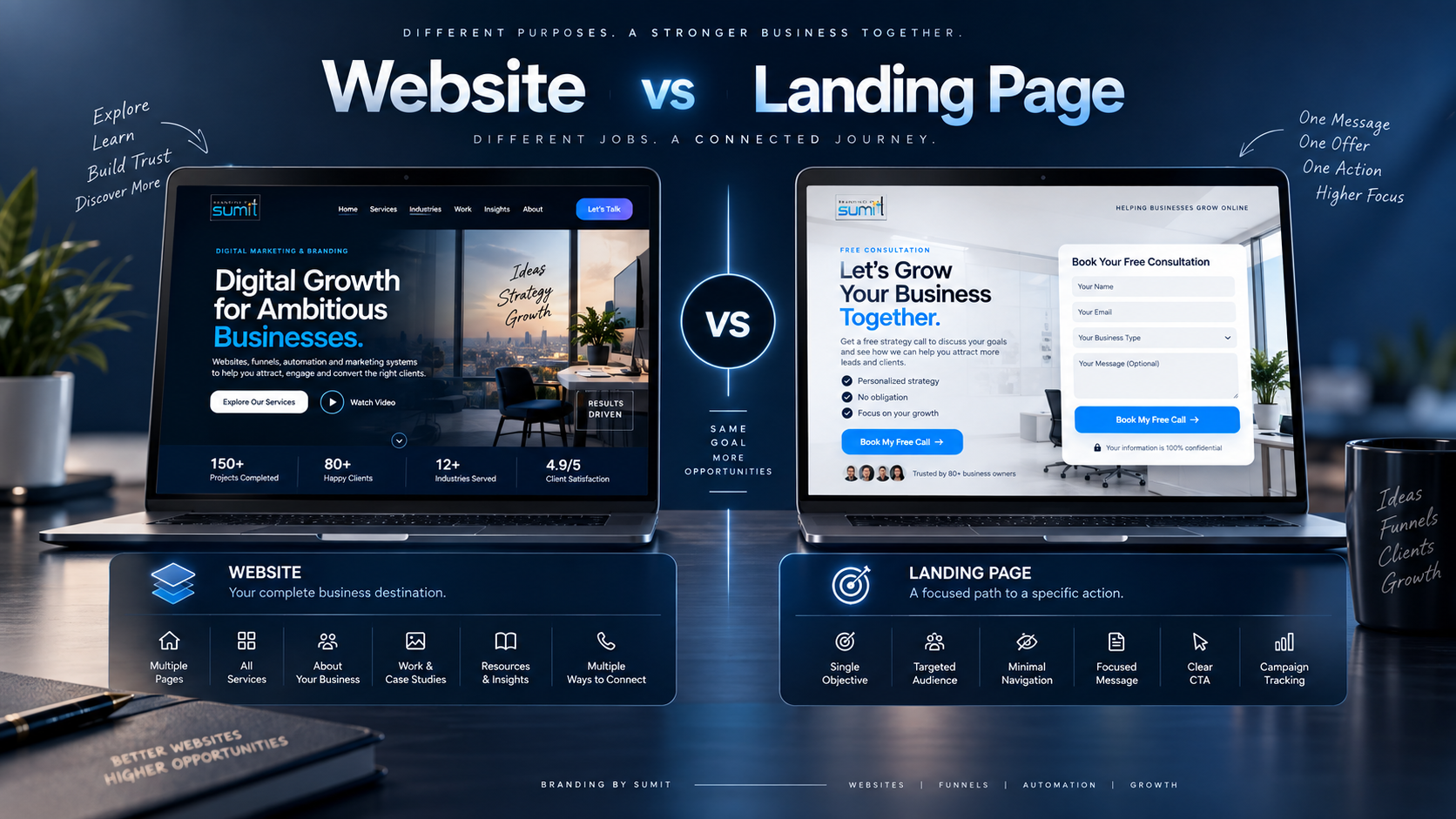
A website is the wider home for your business. It can introduce your brand, show multiple services, explain your approach, provide About and trust content, and give people more than one way to enter. It supports visitors who are still learning as well as those who are ready to enquire.
Multiple reasons to explore one credible business.
That does not mean every website automatically ranks or converts. It means the architecture is designed for breadth: different audiences, different questions, organic discovery and multiple entry points.
WEBSITES & FUNNELS
What a landing page is designed to do.
A landing page narrows the job. It is built around a specific audience, traffic source, offer and primary action. It reduces unnecessary navigation, aligns the message with the campaign that brought the visitor there, and can add qualification at the moment it is useful.
Make the next step clear for this specific offer.
Relevant context, credible reassurance and one focused action.
Qualification cue: tell us what you want to improve.A good landing page is not simply a website with the navigation removed. It connects a specific promise to a specific next step. Explore how this works through Landing Pages & Funnels.
WEBSITES & FUNNELS
Website vs landing page: different jobs, connected system.
Broader business experience
Focused campaign action
Multiple visitor needs
A defined audience or offer
Multiple useful routes
Reduced distractions
Wider brand and service context
One campaign-relevant message
More than one service or path
One primary offer
Research, referral and discovery
Campaign, ad, email or event intent
Explore, learn or enquire
Take one specific action
Useful across broader journeys
Focused around this offer
Supports the environment
Controls the conversion path
More context and validation
Only the context needed to act
WEBSITES & FUNNELS
When your website is enough—and when focus matters more.
Use your website when…
- People are discovering the business or researching broadly.
- They need to explore multiple services or validate credibility.
- Existing referrals want to understand the wider business.
- A general inquiry is the natural next step.
Use a landing page when…
- You are running a paid, email, QR or event campaign.
- One offer needs one clear message and action.
- You need a focused consultation, lead magnet or registration path.
- An audience-specific service needs relevant context.
Adding landing pages to every situation can create unnecessary complexity. The aim is not more pages; it is a better route for the person and campaign in front of you.
WEBSITES & FUNNELS
Decision tree: which one do you need?
WEBSITES & FUNNELS
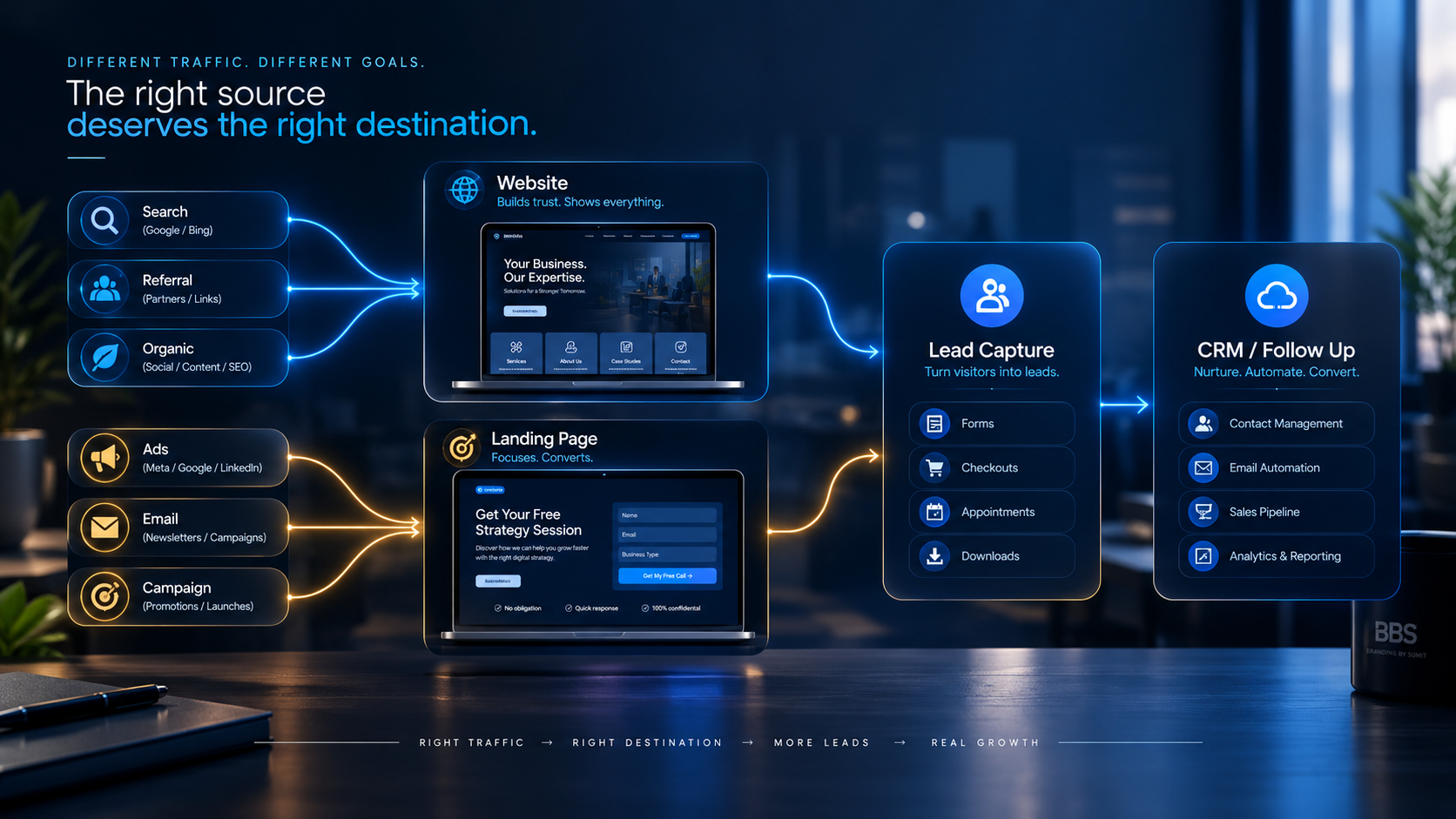
The traffic source changes the answer.
Traffic source is a strategic pattern, not a fixed rule. Search, referrals and social content often need the broader environment of a website. Paid ads, email campaigns and offline calls to action often work best when the destination continues the exact campaign message.
WEBSITES & FUNNELS
Two common mistakes that interrupt a good journey.
Sending every campaign to the homepage
Ad: “Book a specific consultation”
BAD PATH: Ad → Generic Homepage → Search → ConfusionBETTER PATH: Ad → Relevant Landing Page → Clear Next StepBuilding landing pages without trust
Focus does not mean removing everything persuasive. A landing page can still include credible context, process, relevant proof, FAQ, privacy reassurance and expectation setting.
WEBSITES & FUNNELS
Website + landing page: the connected model.
The website builds the wider business environment. Landing pages create focused conversion journeys. Lead capture, CRM and follow-up connect the inquiry to the business so no part of the experience has to work alone.
When the system is connected, website design, landing pages and CRM automation all support the same customer journey.
WEBSITES & FUNNELS
Practical decision checklist.
USE YOUR WEBSITE WHEN…
- Visitors need context, credibility and choices.
- The inquiry is broad or the traffic is exploratory.
USE A LANDING PAGE WHEN…
- One offer or campaign needs one focused action.
- You need a controlled, measurable path.
USE BOTH WHEN…
- The website should build trust before or after the campaign.
- The campaign needs a focused next step.
Frequently asked questions
Do I need a website if I already have a landing page?
Usually, yes. A landing page can support one focused campaign, while a website gives people a place to understand your wider business, services, credibility and resources.
Can a landing page replace a website?
It can support a narrow offer for a period of time, but it is not usually a replacement for a business home with multiple services, trust content and organic entry points.
Should Google Ads go to my homepage or a landing page?
For a specific campaign, a relevant landing page is often the clearer path. For broad or branded searches, a useful website page may better support exploration.
Can landing pages help with lead qualification?
Yes. A focused page can set expectations and ask a small number of questions that help your team understand the visitor’s intent before following up.
How many landing pages does a business need?
Only as many as its distinct campaigns, audiences or offers genuinely require. More pages do not help when they create unnecessary maintenance or unclear journeys.
Should landing pages have navigation?
It depends on the campaign and the visitor’s need for reassurance. A landing page should minimise distractions, while still providing the credible context people need to act.
Can my website and landing pages use the same CRM?
Yes. A shared CRM and follow-up process can keep the lead context connected regardless of where the visitor entered the journey.